Water
At Virginia Tech, water connects us all - whether you're filling up at a refill station, learning about campus cooling systems, or studying how water flows through our local environment. We're making it easier to use water responsibly and sustainably, from investing in stormwater infrastructure to supporting groundbreaking research on water quality.
WATER REFILL STATIONS
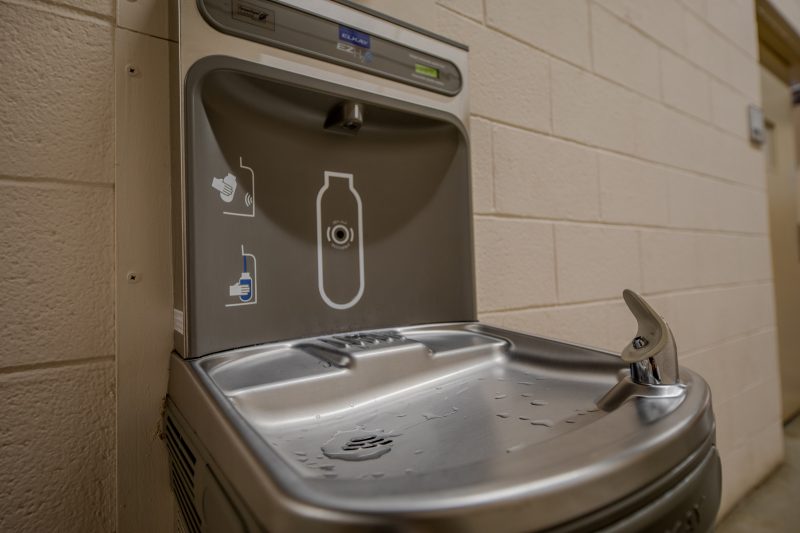
Virginia Tech provides free drinking water at over 75 water fountain/water refill stations across the Blacksburg campus. Located both indoors and outdoors, these stations provide faculty, staff, students, and visitors a convenient way to refill their reusable water bottles.

WASTEWATER TREATMENT

Virginia Tech partners with the Blacksburg-VPI Sanitation Authority to treat about 6 million gallons of wastewater each day from campus and surrounding communities. The facility uses an advanced Autothermal Thermophilic Aerobic Digestion (ATAD) system — the first of its kind in Virginia — to convert wastewater solids into Class A Exceptional Quality biosolids. The process replaces incineration, reducing fuel use and emissions while producing a nutrient-rich material that can be safely reused to improve soil health and support sustainable resource management.
Dwyn Taylor, Vice President for Facilities, was appointed as the Virginia Tech representative and member on the Blacksburg-Virginia Polytechnic Institute Sanitation Authority Board of Directors.
WATER-CONSCIOUS BUILDING STANDARDS
Virginia Tech's Design and Construction Standards state that a new building entering the design phase that is greater than 5,000 gross sq ft, or a renovation of such a building where the cost exceeds 50 percent of its value, shall meet the state’s energy-conservation and water-conservation standards. At minimum, all such buildings shall conform to U.S. Green Building Council LEED Silver standards. A minimum standard for all water-related equipment and fixtures shall meet or exceed the federal EPAct or EPA WaterSense requirements. Additionally, buildings shall minimize water for irrigation through reduced frequency, careful timing, and selection of low-water-use landscaping such as drought-resistant grasses, plants, shrubs and trees.

RAINWATER RECLAMATION SYSTEMS

Virginia Tech’s Design and Construction Standards allow rainwater reclamation systems as a sustainable water strategy, with specific engineering requirements to ensure safety and reliability. Any reclaimed rainwater used within buildings must be reviewed and approved by the Office of the University Engineer. Systems must include disinfection, such as ultraviolet or chemical treatment, along with filtration before the reclaimed water is supplied to fixtures. Each system must also integrate a municipal water backup with a backflow preventer, and all piping must be clearly labeled to distinguish reclaimed water from potable supplies.
Several buildings utilize rainwater reclamation systems, such as the Fralin Biomedical Research Institute and Innovation Campus Academic Building One.
WATER DISCHARGE GUIDELINES
Virginia Tech’s stormwater management program ensures responsible discharge of runoff through a regulated Municipal Separate Storm Sewer System (MS4) permit and compliance with state and federal water-quality standards. The university’s approach includes detecting and eliminating illicit discharges, managing runoff from construction and redevelopment projects through Stormwater Pollution Prevention Plans, and maintaining systems that protect campus waterways. Construction or modifications to open channels must also comply with all applicable environmental laws and regulations. Project teams are responsible for securing required permits, such as U.S. Army Corps of Engineers and Virginia Department of Environmental Quality (DEQ) wetland or Virginia Pollutant Discharge Elimination System (VPDES) permits, before receiving final site design approval. Together, these practices help safeguard local streams and aquatic ecosystems while supporting sustainable campus development.